


How We Govern Our Minds Through Others
Epistemic Autonomy Beyond the Myth of Independence
Carter, J. A. and N. Levy (2026). How We Govern Our Minds Through Others: Epistemic Autonomy Beyond the Myth of Independence, MIT Press
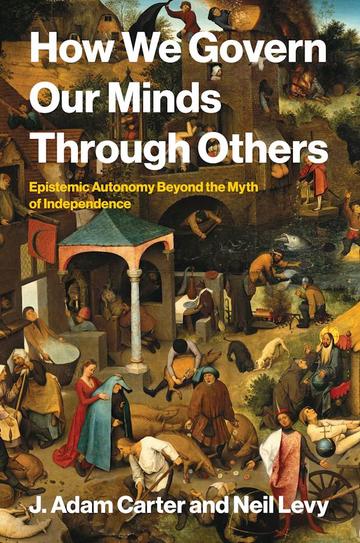
Epistemic autonomy worth valuing requires epistemic dependence on others, as well as on tools and technology.
In How We Govern Our Minds Through Others, J. Adam Carter and Neil Levy argue that epistemic autonomy worth valuing requires various kinds of epistemic dependence on others, as well as on tools and technology. Challenging the Cartesian ideal of self-sufficient knowledge acquisition, they show that epistemic dependence is both inevitable and beneficial. Self‑governance is mediated by social relationships and institutions; we manage our beliefs and attention through collaborations, trust, and the influence of others. What emerges is a reconceptualization of epistemic autonomy as deeply social and deeply scaffolded.
Integrating insights from philosophy, cognitive science, AI ethics, and media studies, the authors offer a positive, socially scaffolded conception of epistemic self‑governance. The topics they explore include epistemic autonomy in connection with hijacked attention, intellectual collaboration with others in group settings, artificial intelligence, first-hand insight, nudging and questioning, epistemic feedback loops, and adaptive control. Their arguments have ramifications for educators and designers of digital platforms, as well as those working in the emerging landscape of AI law, digital rights, and mental privacy.
Open Access
The open access edition of this book was made possible by generous funding and support from MIT Press Direct to Open. It is made available under a CC BY-NC-ND International licence and is free to read and download on the MIT Press Direct platform.
Funder
The book is an output of an AHRC Grant 'Epistemic Autonomy' (AH/W005077/1). We are grateful to the Arts and Humanities Research Council (AHRC) for funding this collaborative project with the University of Glasgow.
Book Metadata
- Open access under CC BY-NC-ND licence
- Paperback
- ISBN: 9780262056458
- https://doi.org/10.7551/mitpress/17114.001.0001
- Pub date: October 13, 2026
- Publisher: The MIT Press
- 202 pp., 6 x 9 in, 6 b&w figures

